Harvey Lee wrote about an employee who left her annual review in tears. She was good — genuinely excellent. Hardworking. The kind of person you want on your team. And she was blindsided.
Not because she had failed. Because the review wasn't measuring what she thought it was measuring.
Siva read that piece and found himself peering, in his words, into a crystal ball spinning backwards — pulling out every annual review he had been part of, from every side of the table. As a young engineer working hard and hoping someone would notice. As a manager having to deliver ratings that didn't feel fair. As a leader watching people he had mentored walk in underprepared, certain they would be seen.
Harvey Lee's article names seven things that catch people off guard: bell curves, recency bias, compensation decisions made by committees you'll never meet, self-evaluations treated as afterthoughts when they are among the highest-leverage moments in the whole process. Read it. It's useful.
But reading it, Siva's mind went somewhere else. Not to tactics. To the system itself — and to the question of how a conscious leader intervenes before the room, not inside it.
Donella Meadows spent her career studying how complex systems work — and where you can actually change them. Her essay on leverage points is one of the most quietly radical things written about organisational life, even though it was written about economies and ecosystems.
When Siva looks at the annual review blindside, he sees a systems problem. The hardworking employee was reaching for the lowest-leverage point — output, effort, technical delivery. The system was measuring something different: visibility, narrative, relationship, strategic alignment. Neither of them had made that mismatch visible until the room.
As a conscious leader, his response isn't to teach people better review tactics. It's to intervene at the leverage points — all year, not just before review season.
Help people tell their own story.
The hardest workers are often the least visible. Not because they are hiding — but because they are heads-down. In the system, heads-down looks like absence. It looks like: I'm not sure what she's been doing. It looks like the gap between what the person knows they have delivered and what the organisation has registered.
Creating early awareness — waking people up to tell their stories — is a leverage intervention at the level of information flow. You are not asking them to work differently. You are asking them to surface what they have already done, to find the words for it, to make it legible to the people who are forming impressions of them across twelve months.
It is not self-promotion. It is self-representation. The difference matters.
Help people own their growth.
Every organisation has its own grammar. What "good" looks like. What "visible" means. What kinds of contributions get credited, and by whom. This grammar is rarely written down — but it shapes every review, every promotion decision, every room where someone's name comes up without them in it.
Siva's second practice is helping people read that grammar and move within it deliberately. Strengthen the networks that amplify your work. Understand the cultural dictums of where you are. Own your growth as something you are doing actively — not something that is happening to you.
In Meadows' frame: this is helping people understand what the system is actually optimising for, so they can act on that understanding — rather than optimising hard for the wrong thing and being surprised when it isn't rewarded.
Help people rewire priorities.
Most high performers have built their identity around technical excellence. That identity is often what made them good. It is also, at some point in the career arc, what holds them back.
The system begins to ask different questions. Can you operate at the intersection of technology and business? Can you influence across functions? Can you see the strategic picture and bring others along with you?
Helping people rebalance — not abandon their technical depth, but weave it into a broader operating range — is a leverage intervention at the level of goals. You are not changing what they do so much as what they are trying to become. That shift, when it happens, tends to compound.
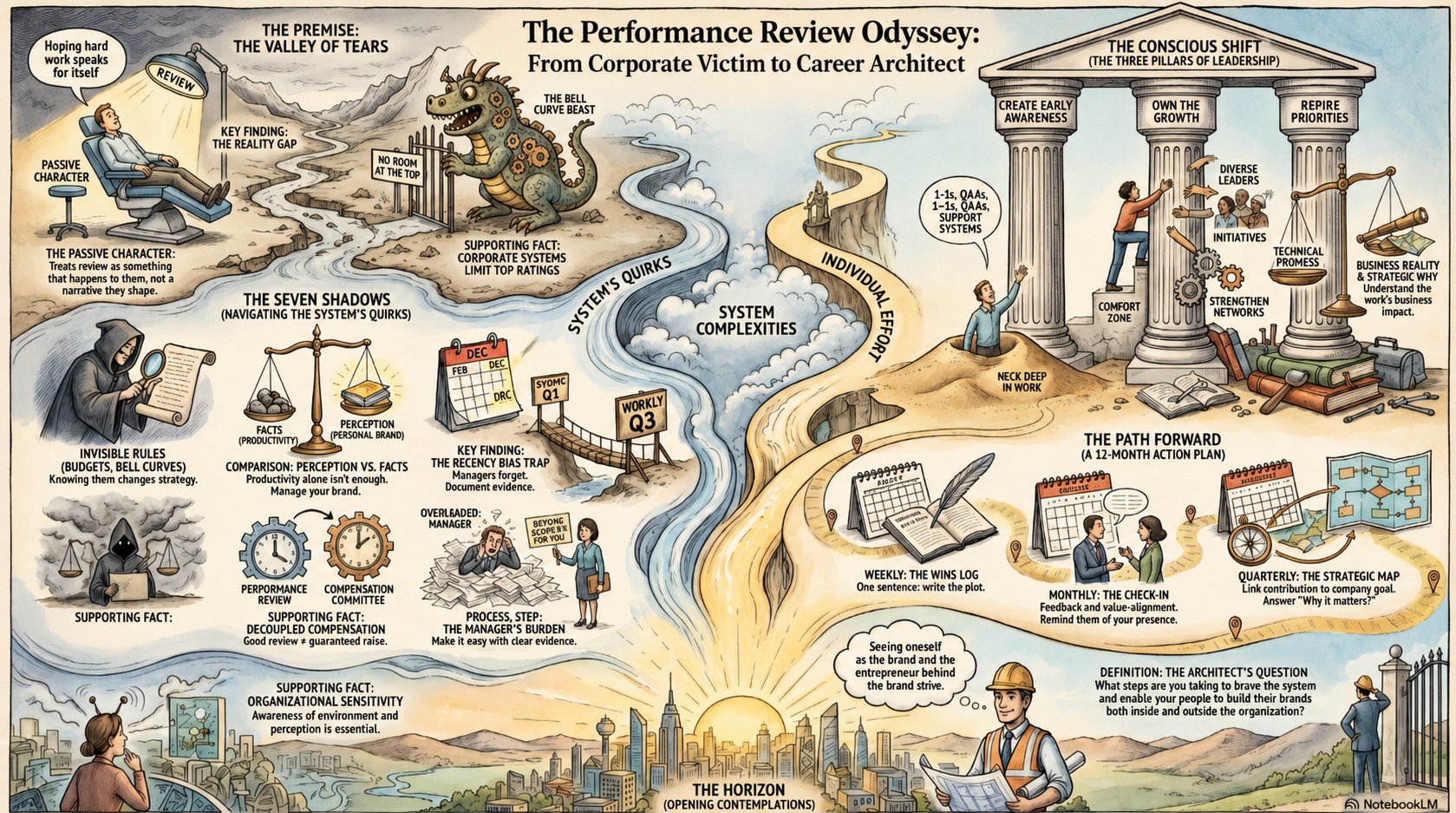
What small (or big) steps are working well for you as a conscious leader — in changing the status quo and braving the system to help and enable your people:
- to understand the environment they are part of?
- to understand themselves and how they are perceived by others?
- to build organisational awareness and sensitivity to the implied realities?
- to build their brands within and beyond the organisation?
- to build long-term business orientation and acumen, beyond their immediate technical prowess?