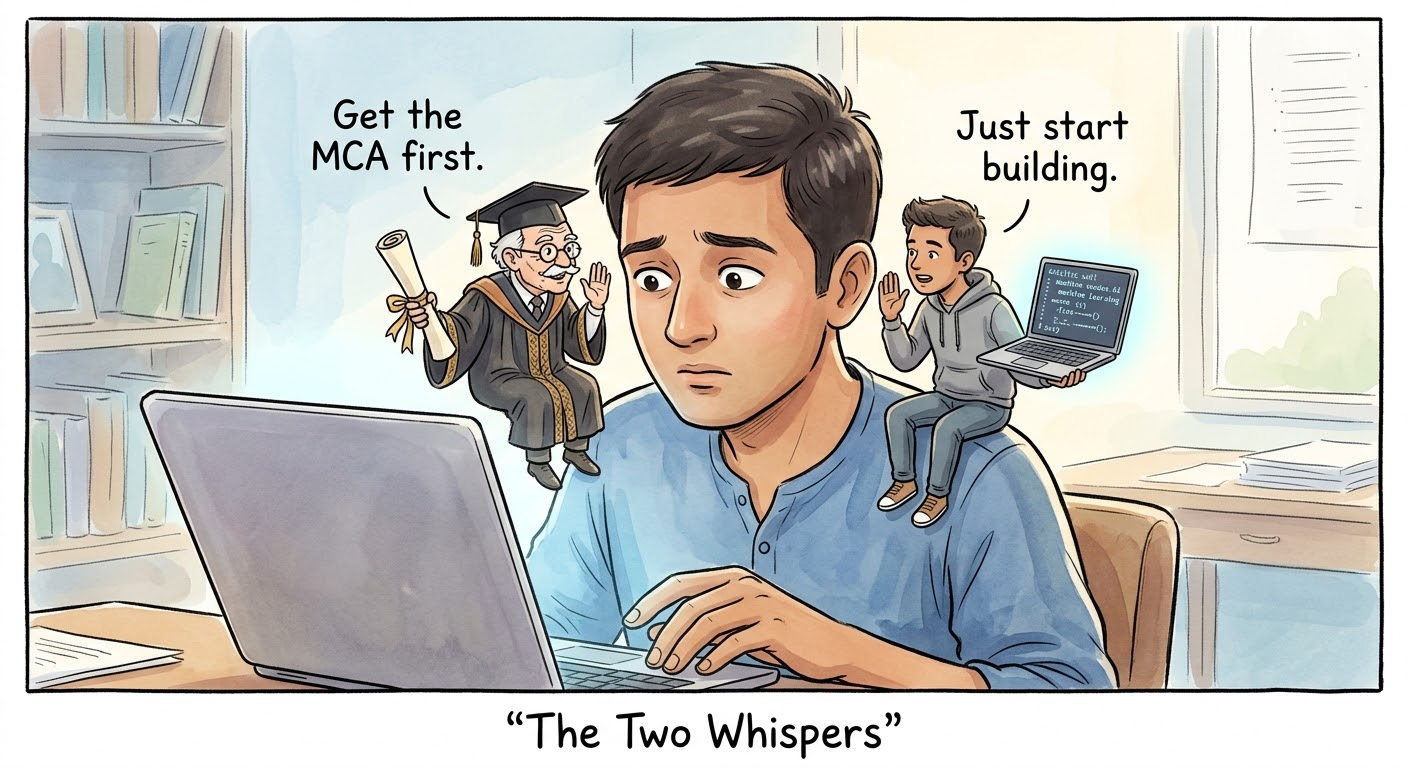
A family came to me this week with a question I haven't been able to put down.
Their son finished his BCA and has been looking for work. So far, nothing. The question they brought me, plainly: should he do an MCA?
The cost would be five or six lakh rupees. For most of the people I work with, that's a number. For this family, it's years of careful saving.
I haven't given them my answer yet.
If I had to commit today, I'd push the other way.
Don't spend the money. Don't enrol in another two-year programme. Take any reasonable first job — the kind a fresh BCA can plausibly land. Spend two or three years there. Learn how production systems are built. Learn what AI tools actually do in working hands. Build a portfolio of real things, however small. Then — if a specific gap remains — fill it deliberately. Not preemptively. Not with someone else's curriculum.
In the age we're now in, capability is overtaking credential faster than most curricula can update. A BCA graduate with two years of real work and fluent AI tooling is, in my view, better positioned in 2028 than a fresh MCA holder with no industry exposure. That's my instinct.
But the cost of being wrong here is not mine to bear. So I'm not ready to deliver this view as advice.
Before I answer the family, I wanted to test that instinct against people who'd think differently than I do. I put the question to my CTO peer group. I put it on LinkedIn. I put it on WhatsApp.
The picture converged — but with nuance worth holding on to.
The dominant view: start with the job. Across LinkedIn and WhatsApp, response after response landed in roughly the same place — get him into a job first, learn on the work, layer formal education on top later if at all.
The nuance most respondents added: it's not either/or. The false binary I had been holding — MCA or job — dissolved in the responses into something better: job, with learning layered on, in whatever form fits the family's wallet and the young man's energy.
The sharpest counter-point cut to the bone. It's not just a question of credential versus capability — it's a diagnostic question I hadn't asked clearly enough. What, specifically, is keeping him from being hired? Is it a portfolio gap, an interview-skills gap, a network gap, a confidence gap, a geography gap? Each of those has a different remedy. None of them is "another two-year degree."
The one scenario where MCA does make sense was named cleanly.
So the right question isn't MCA, yes or no. It's which MCA, on what terms, against what alternative.
Proof of work, not credentials. A shift two voices named separately.
That reframes the immediate task. The first move isn't get hired, or get more degrees. It's show your work — however small.
The hard truth: this advice needs grit. The most honest pushback of the day.
Praveen offered a concrete data point too: a colleague who, after becoming a manager at Accenture, completed a three-year MCA part-time to qualify for the next rung. Education did its work later, on top of established footing — not before it.
My instinct hasn't moved. But it has gained edges. Closer to the advice I'm now ready to give the family:
- Diagnose first. Before spending a rupee on more education, understand precisely why the first job isn't landing. Talk to people who have recently hired BCA graduates. Look at his CV, his portfolio, his interview process with fresh eyes.
- Get into any reasonable first role. The first job is rarely the dream job. It is the foundation everything else stands on.
- Learn relentlessly on the side. AI tools, real projects, open-source contributions, online courses — whatever closes the specific gap the diagnosis surfaces.
- If a formal degree still makes sense after that, do it part-time or by correspondence. Don't burn a year and a half of family savings preemptively. Let the work tell you what credential, if any, is worth chasing.
- Test the temperament before giving the advice. This path needs grit. Grit can be sensed in conversation. If it isn't there, this advice won't help — and other forms of support might serve better.
- Make proof of work the first goal, not the first job. Even before applying, build something small and public — a GitHub repo, a working prototype, a Loom walkthrough. The first job tends to follow that, more often than it precedes it.
- Treat MCA as a serious question only if a top-tier programme is on the table. Outside that narrow case, the question itself is a misdirection. The work-first path becomes the only one worth taking seriously.
Three questions this exercise surfaced that I don't yet have clean answers to.
There is no right or wrong here. What works for this young man and his family will depend on things only they can see clearly — temperament, ambition, money, the weather inside a specific home. The decision is theirs.
But as tech leaders, looking at the working world we actually inhabit: real work experience now carries far more weight than a degree. That isn't a slogan. It's what the people who hire, build, and lead the teams he hopes to join will tell you, almost without exception.
The decision is theirs. The weighting is ours.
If you have a view I haven't yet captured — a story of someone who took the work-first path, a reason the MCA absolutely was the right call, a question I should have asked instead — I'd love to hear it.
Reply on the LinkedIn post, message me on WhatsApp, or write directly. The picture is converging, but the conversation is still open.